BLOG 1 : GEAR DOCUMENTATION
- dhasna22
- Nov 19, 2023
- 3 min read
Hello im dhasna , and ill be blogging about my journey in the module CP5070!!
These are the definition of gear module, pitch circular diameter and the relationship between gear module, pitch circular diameter and number of teeth
Firstly, Gear module is the size of the gear teeth.The bigger the module number, the larger the size of the teeth. Gears that mesh together have the same module . The unit used for gear module is mm.
Next, Pitch circular diameter is the diamter of the imaginary circle that passes through the center of the gear teeth which is also calculated in mm.
The relationship between these two definations can be understood through the formula m= PCD/z
m : Gear module (mm)
PCD : Pitch Cirular Diameter (mm)
z : Number of teeth
2. Below is the relationship between gear ratio(speed ratio) and output speed for a pair of gears and between gear ratio and torque for a pair of gears
Gear ratio is inversely proportionate to the output speed. When gear ratio increases, output speed decreases.
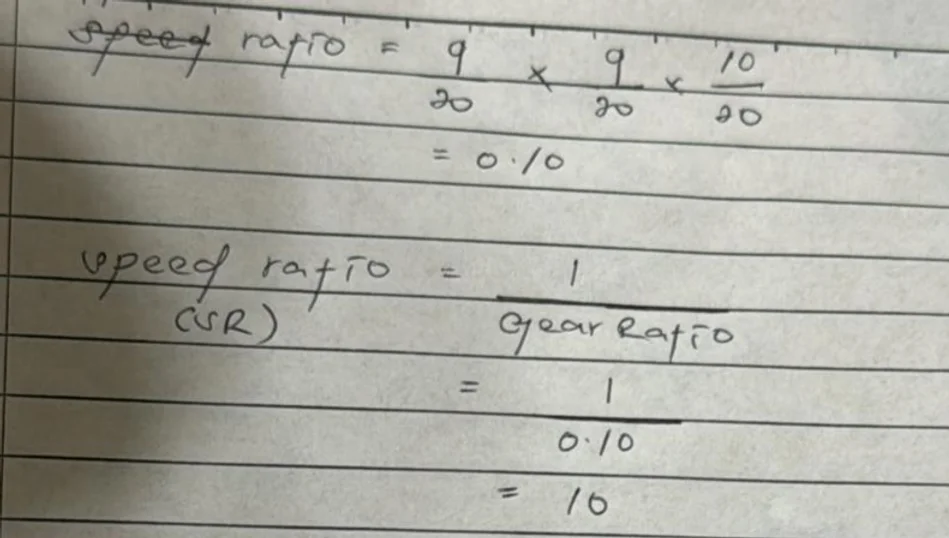
Gear ratio can be calculated by the formula

Gear ratio is directly proportionate to torque for a pair of gears. The greater the gear ratio is , the higher the torque of the output. When gear ratio is more than 1 , torque is maximised. When gear ratio is less than 1, torque is minimised.
3. Proposed design to make the hand-squeezed fan better
We started by keeping in mind that we wanted to achieve as many rotations as possible in one squeeze so that the fan will spin faster . Thus, we decided to keep the gear ratio less than 1 giving us 0.1 which resulted in our speed ratio in being 10. Below is the drawing o fthe inside set-up of our fan, the calculations and the video of our fan spinning . We managed to achieve 5 spins in ine squeeze! Adding on, the big gear had 20 teeth and the small gear 9 teeth.

4. Below are the description on how my practical team arranged the gears provided in he practical to raise the water bottle.
(a) Calculation of the gear ratio (speed ratio)

(b) Photo of the actual gear layout

(c) Calculation of the number of the revolutions required to rotate the crank handle

5. My learning reflection
I came into this whole gear concept and gear practical with the idea that its a simple concept to grasp and that gears meshed together in any way will always work. Although the idea is there, i have learnt meshing gears in any where may not necessarily produce out desired outcome. A lot of technical concepts have to be looked into. Gear ratio,output speed and torque.
During the practical, the part where we had to set up the gears in order to lift the water bottle, we had to try and try and try again to achieve a gear ratio that was high. It was definately not easy trying to figure which was the best way to assemble the gears so as to get a high gear ratio. A lot of persistnace was in work! Although we didnt hit the highest gear ration is assembling we managed to reach about 17+.
The hands practical made me understand how such gears works not only for small items but is also incorparated in large machines, i understood how minute changes affects the total outcome of the gears in motion since i was able to try and work with the gears and assembling them differently.
I have learnt how to combine my theoretical knowledge when i am perfoming a hands on practical . In my other module, we are encouraged to not rely on theoretical knowldege completely and to instead seek solutions based on the problem in front of us. However, in this practical i had to keep looking back at the equations and understanding the theory of gears to acheieve our goal which is to both make a better squeeze fan and be able to lift a water bottle.
Adding on , i have also realised that i have to be more flexible in coming with solutions with a fixed mindset as im simply forcing a correct answer although i know i will not be able to attain it. I now apprecaite the mechanics of gears, as it may look like its simple to grasp the concept however so much more complexity i within it which i haev learnt to uncover through this practical.


Comments